
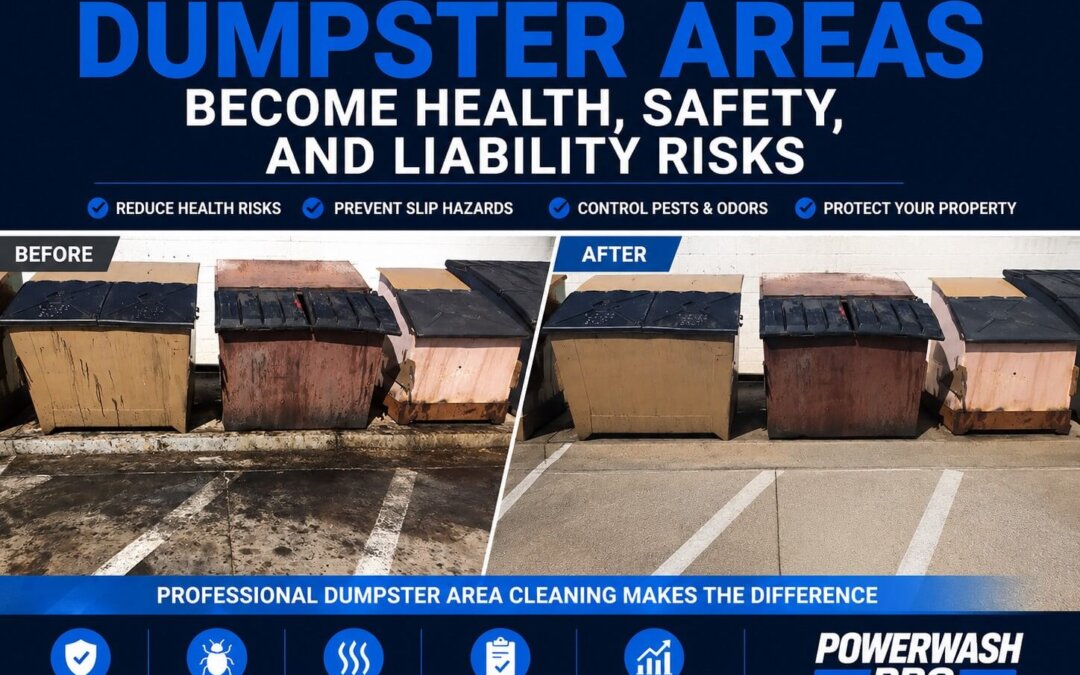
When most restaurant owners think about cleanliness, they focus on dining rooms, kitchens, and customer-facing areas. While those spaces deserve attention, one of the most overlooked areas on nearly every restaurant property is also one of the most important: the dumpster area. After more than 25 years providing restaurant cleaning services, commercial pressure washing, hood cleaning, and facility cleaning throughout Arizona and New Mexico, we have found that dumpster enclosures are often the single largest source of grease buildup, odors, pest activity, slip hazards, and property deterioration. Unfortunately, these issues rarely develop overnight; they build gradually over time until a property manager suddenly faces complaints from customers, health inspectors, tenants, or employees. The good news is that nearly all of these problems can be prevented through a proactive cleaning and maintenance program.

The Real Cost of Neglecting Dumpster Areas
Many restaurant operators don't realize that a neglected dumpster area can affect far more than the rear of the building. Employees often track grease and debris from dumpster enclosures into service corridors, kitchens, and storage areas. Over time, this increases cleaning costs throughout the facility and creates additional sanitation concerns that can compromise internal food safety standards. Furthermore, when these areas are visible to the public or adjacent businesses, they rapidly degrade the brand image of your establishment. Customer complaints regarding odors or "dirty" surroundings are often the first sign that the exterior maintenance program is failing. These complaints are not just feedback; they are warnings that you are likely on the verge of a poor health inspection report or a preventable safety incident.
Arizona Climate Challenges: The "Baking" Effect
Operating in Arizona adds a significant layer of difficulty to exterior sanitation. From the intense heat in Tempe to the high-traffic corridors of Chandler, our extreme summer temperatures—regularly exceeding 110°F—don't just cause odors; they physically bake organic contaminants and animal fats deep into the microscopic pores of your concrete substrate. Once grease is "baked in," it is no longer just a surface stain; it is part of the material. During monsoon season, that hardened, saturated buildup can be washed into storm drains or, worse, create an extremely slick, hazardous slurry on your walkways. Standard cold-water rinsing is effectively useless against this type of baked-on residue. It requires a professional approach that combines the correct specialized degreasers with high-temperature, high-pressure hot water to emulsify the oils and extract them from the concrete pores.
Recommended Dumpster Cleaning Frequencies
| Property Type | Recommended Frequency |
|---|---|
| Fast Food | Monthly |
| Casual Dining | Monthly |
| Fine Dining | Monthly |
| Grocery Stores | Monthly |
| Food Processing | Biweekly |
| Convenience Stores | Monthly |
The Hidden Slip Hazard
One of the most significant risks associated with neglected dumpster areas is the creation of dangerously slick walking surfaces. Grease residue, when combined with water, spilled beverages, and organic waste, creates a low-friction surface that is a magnet for slip-and-fall accidents. Employees carrying heavy trash loads, moving racks, or accessing the rear entrance are often walking through these zones multiple times per day. Even a minor slip-and-fall incident can result in costly workers' compensation claims, lost staff productivity, significant medical expenses, and potential long-term liability exposure for the property owner. Regular, scheduled pressure washing removes this accumulated grease film long before it reaches a critical safety threshold.
Pest Control and Sanitation
Many restaurant operators spend thousands of dollars annually on pest control services while completely overlooking the primary attractant: food waste and grease accumulation in the dumpster area. Rodents, insects, and flies are opportunistic feeders; they are biologically programmed to detect food residue and organic decay. When dumpster pads remain dirty, they effectively become a permanent, reliable food source for local pest populations. While professional pest control is necessary, cleaning the pad removes the attractant itself. By eliminating the food residue, odor-producing organic material, and bacteria-laden grime, you create an environment that is far less hospitable to pests, significantly increasing the effectiveness of your pest control investment.
A Real Example From the Field
We recently evaluated a multi-unit restaurant location that had gone nearly a full year without professional dumpster area cleaning. When our team arrived, the concrete had become fully saturated with black, oxidized grease. The odors were so noticeable that they could be detected from the employee entrance, and management reported a sharp increase in fly activity near the rear of the kitchen. After a comprehensive restoration cleaning—which required high-heat water and specialized chemical emulsifiers to break down the hardened grease—and the implementation of a recurring monthly maintenance schedule, the property was transformed. The ongoing maintenance became significantly easier and less expensive than the initial corrective restoration, proving that proactive programs protect both your budget and your property's structural integrity.
The Technical Difference: Hot Water vs. Cold Water
At PowerWash Pro, we do not simply "spray water." Commercial dumpster cleaning requires a deep technical understanding of soil chemistry. Grease and animal fats are hydrophobic; they do not break down with cold water, which often just pushes the contaminant into the next area. We utilize commercial-grade, hot-water-fired pressure washing systems that reach high temperatures, allowing us to emulsify oils at a molecular level. This ensures that when we rinse the surface, the grease is actually lifted and removed, rather than just relocated. This professional methodology is essential for maintaining the recommended commercial property cleaning frequencies we establish for our clients as part of our broader commercial pressure washing and facility cleaning offerings.
Dumpster Areas Are Often the First Sign of a Failing Maintenance Program
In our experience, when a restaurant's dumpster area is neglected, it is often an indicator that other maintenance items are being deferred as well. Grease buildup around dumpsters frequently accompanies dirty drive-thru lanes, stained sidewalks, neglected loading zones, and overdue hood cleaning services. By addressing these issues proactively through a recurring maintenance program, restaurant operators can maintain a cleaner, safer, and more professional property while reducing long-term costs.
Frequently Asked Questions
For most restaurants, a monthly schedule is recommended to prevent grease saturation and odor buildup. High-volume locations or food processing sites may require biweekly service to stay ahead of organic accumulation.
Yes, provided you are using the correct equipment. We use industrial-grade hot water and specific degreasers to emulsify and remove deep-seated grease that cold-water equipment cannot touch.
Absolutely. Food residue, liquid spills, and grease buildup are the primary attractants for rodents, flies, and other pests. Cleaning the pad effectively removes their food source.
Yes. Hot water is critical for breaking down animal fats. Without it, you are essentially just pushing grease across the concrete surface rather than removing it.
Yes. Grease residue on concrete creates a very low-friction surface, especially when damp. Regular pressure washing removes this buildup and helps keep employees safe.
Managing Multiple Locations
For restaurant groups managing multiple locations, consistency becomes one of the biggest operational challenges. A location in Chandler may be receiving regular service while another location in Tempe is falling behind. Our Facilities Portal gives restaurant owners, district managers, and regional managers centralized visibility into every completed service visit. Photos, notes, invoices, and service history are stored in one place, making it easy to verify compliance and maintain brand standards across an entire portfolio. If you are ready to implement a professional maintenance program, contact us today.