
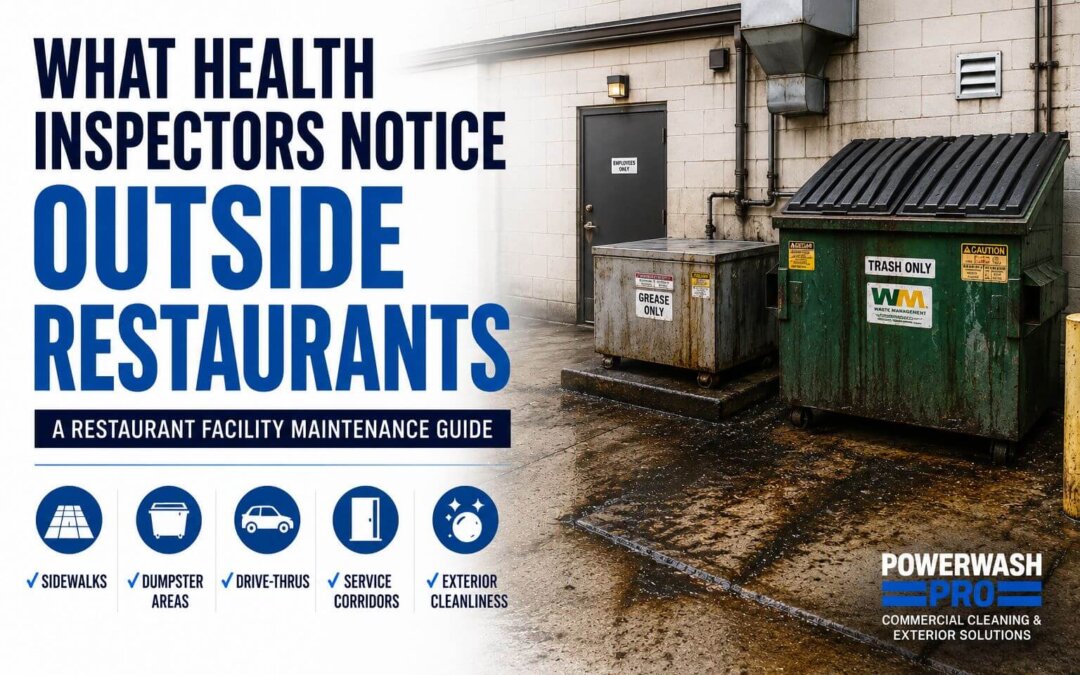
What Health Inspectors Notice Outside Restaurants
When restaurant owners think about health inspections, they usually focus on the kitchen. Managers check food temperatures, employees scrub prep stations, and storage areas are meticulously organized. While all these internal measures are essential, many restaurant operators overlook an important reality: Health inspectors often begin forming opinions about a facility long before they enter the kitchen.
After more than 25 years providing professional restaurant cleaning, hood cleaning, and commercial pressure washing services throughout Arizona and New Mexico, we’ve seen firsthand how exterior property conditions often mirror the standards maintained inside the building. Properties with strong exterior maintenance programs almost always maintain higher standards throughout the rest of the operation.
What Inspectors See Before They Ever Enter The Building
Most restaurant operators assume an inspection begins when the inspector walks into the kitchen. In reality, inspections often begin in the parking lot.

Before entering the building, inspectors may observe overflowing trash containers, grease accumulation near service areas, standing water, employee smoking areas, drainage conditions, pest activity, and the overall appearance of the property. While these observations may not automatically result in violations, they contribute to an overall impression of how seriously the facility approaches sanitation and maintenance. After 25 years in the field, we’ve found that inspectors take note of these external details as a "barometer" for what they should expect to find once they step inside.
One common situation we see involves a restaurant that keeps an exceptionally clean dining room but neglects the dumpster enclosure behind the building. Over time, grease accumulates around the pad, odors develop, and pest activity increases. Management may never notice because customers rarely see the area. However, inspectors, property managers, and vendors frequently do.
This disconnect between interior and exterior maintenance is one of the primary reasons we recommend comprehensive facility maintenance programs rather than focusing on a single area of the facility. If the back of the house is neglected, it creates a vulnerability that an inspector will likely explore further.
Health Inspections And Customer Perception Often Overlap
Many of the same issues that concern inspectors also affect customers. Overflowing dumpster area cleaning, grease buildup, foul odors, and dirty sidewalks can influence how guests perceive a restaurant long before they place an order. Maintaining a clean exterior benefits both inspection readiness and customer confidence. When an inspector sees a property that is cared for, they are often walking into a facility where the staff already understands that "cleanliness is everyone’s job."
Why Consistency Matters More Than Occasional Deep Cleaning
One mistake we frequently see is restaurants waiting until a health inspection, corporate visit, or customer complaint before addressing exterior maintenance. While a large one-time cleaning can dramatically improve appearance, the results are often temporary if the property does not transition into a recurring maintenance schedule.
Restaurants generate grease, food residue, traffic patterns, and contamination every day. The most successful operators treat exterior maintenance the same way they treat kitchen sanitation: as an ongoing process rather than an occasional event. In our experience, restaurants maintained on a consistent schedule not only look better but are also easier and less expensive to maintain over the long term.
The Grease Migration Problem
One of the most common issues we encounter is grease migration. Grease rarely stays confined to the kitchen; it eventually appears on sidewalks, dumpster pads, and drive-thru lanes. As detailed in our recent guide on grease migration from exhaust systems, these contaminants often originate from rooftop fans and spread throughout the property. When an inspector sees grease pooled near a service corridor or drive-thru, it suggests that internal maintenance programs—including your hood cleaning schedule—may not be performed with the necessary consistency.
Drainage, Pests, and Regional Challenges
Inspectors often note standing water or poor drainage, which can attract mosquitoes and foster organic growth. Furthermore, many pest issues originate outdoors—attracted by food waste and grease buildup—before moving inside. For restaurants in Chandler, Tempe, Scottsdale, Gilbert, Buckeye, and Albuquerque, environmental factors like extreme heat and dust storms accelerate these issues, effectively "baking" contaminants into porous surfaces. Proactive cleaning is the only way to manage these regional challenges effectively.
Managing Consistent Standards Across Locations
For multi-location restaurant groups, maintaining consistent standards across every property is a significant challenge. PowerWash Pro’s Facilities Portal supports recurring maintenance programs by providing full visibility into service history, before-and-after photos, and work order documentation from one centralized dashboard. This ensures facility managers can verify that standards are met at every location, from the dumpster pad to the front entrance.
Frequently Asked Questions
While sidewalks themselves may not be a direct food-safety violation, they provide inspectors with clues regarding your facility's overall commitment to sanitation.
Absolutely. Customers often form opinions before entering the restaurant. Dirty sidewalks, visible grease buildup, odors, and neglected dumpster areas can negatively impact the perception of cleanliness and professionalism.
Yes. Dumpster enclosures are frequently inspected to assess sanitation levels, waste containment, and potential pest control risks.
Yes. Food residue and grease act as major attractants for rodents and insects, often leading to interior pest issues.
Frequency depends on your specific traffic levels and local environment. Most restaurants benefit from a recurring monthly or quarterly maintenance schedule.
Final Thoughts
Health inspections do not begin when an inspector walks into the kitchen; they begin the moment they pull into your parking lot. Clean sidewalks, well-maintained dumpster areas, and professional exterior conditions demonstrate a high level of operational excellence. Combining routine hood cleaning with recurring restaurant cleaning services protects your brand image and ensures your property remains professional from the rooftop to the sidewalk. If your property is ready for a professional maintenance audit, contact us today to create a customized solution that protects your brand and keeps your property inspection-ready.