
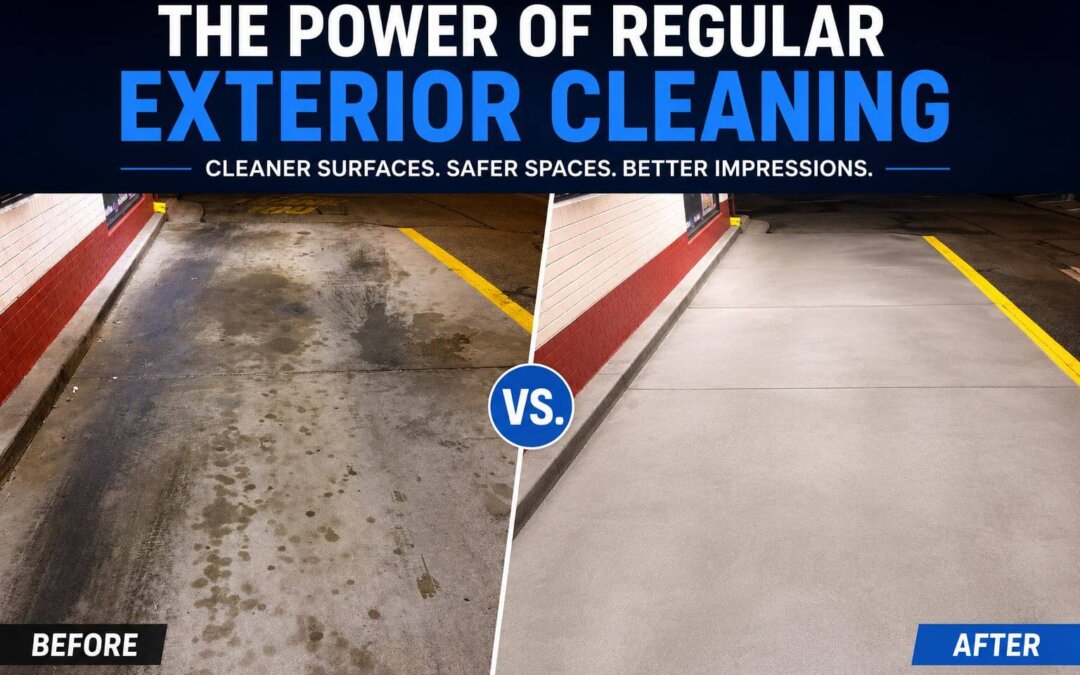
"For many restaurants, the drive-thru is the most heavily used part of the entire property."
After more than 25 years providing professional restaurant cleaning, hood cleaning, and commercial pressure washing services throughout Arizona and New Mexico, we’ve found that drive-thrus are often among the fastest deteriorating surfaces on restaurant properties. Thousands of vehicles pass through these lanes every month, leaving behind a complex mix of contaminants that, if left unaddressed, become costly to restore.Why Drive-Thrus Are Often The First Area Customers Judge
For many quick-service restaurants, the drive-thru generates a significant percentage of total sales. Unlike traditional diners who spend most of their time inside the building, drive-thru customers may never enter the restaurant at all. The drive-thru lane becomes their entire customer experience. Customers spend several minutes looking directly at the pavement, menu boards, landscaping, curbs, and service windows while waiting for their order. If the lane is covered with stains, gum, grease, and discoloration, it can subtly impact how customers perceive the brand. In many cases, the drive-thru creates the very first and very last impression a customer has of a restaurant.Why Drive-Thrus Get Dirty Faster Than Most Exterior Surfaces
Unlike sidewalks or parking areas, drive-thru lanes concentrate traffic into a narrow corridor. Every vehicle follows the same path, stops in the same locations, and accelerates from the same positions. This repeated activity creates concentrated contamination zones made up of tire residue, brake dust, engine oil, transmission fluid, beverage spills, food debris, and tracked-in grease. Because these contaminants accumulate in predictable locations, drive-thrus often become visibly stained much faster than other areas of the property.
The Three Critical Zones of Drive-Thru Contamination
In our experience, drive-thru contamination isn't uniform; it concentrates in three specific areas where vehicles idle and customers interact with the service process:- The Menu Box: This is the primary spot for order placement, where customers often discard gum or accidentally drop food while preparing to order.
- The Pay Window: As customers stop to exchange payment, the frequency of spills and discarded gum increases significantly.
- The Food Pickup Window: This final stop is a high-traffic zone for spills—specifically soda, milkshakes, and coffee—as customers manage their new meals.
A Pattern We See Repeatedly
One pattern we've observed over the years is that drive-thrus are often the last area restaurant operators think about and the first area customers notice. Management teams frequently focus on dining rooms, restrooms, and kitchens while drive-thru lanes accumulate years of staining. By the time the discoloration becomes obvious, contaminants have often penetrated deep into the surface. At that point, restoration becomes far more expensive than routine maintenance would have been. In many cases, drive-thru contamination is not isolated to vehicle traffic alone. Grease migration from rooftop exhaust systems often contributes to the buildup seen throughout the property. We explore this process in detail in our guide on how grease travels from restaurant exhaust systems to sidewalks and concrete.Geographic Differences: Arizona vs. New Mexico
Our work across the Southwest highlights significant geographic and economic variables in maintenance. Restaurants throughout Chandler, Tempe, Scottsdale, Gilbert, Buckeye, and Phoenix face intense heat that "bakes" oils and vehicle fluids into the concrete. In markets like Albuquerque, we often see older model vehicles that are more prone to mechanical leaks. This leads to a higher concentration of oil and transmission fluid stains. Regardless of the location, extreme desert conditions ensure that these contaminants don't just sit on the surface—they become permanently embedded.Why Hot Water Makes Such A Difference
Many drive-thru contaminants are oil-based or sugar-based. Cold water can remove loose debris, but it struggles to break down deep-seated grease and sticky residue. PowerWash Pro utilizes commercial-grade hot-water pressure washing systems specifically designed to dissolve oils, lift embedded contamination, and restore surfaces more effectively. This is one reason professional facility cleaning programs rely on high-heat equipment rather than standard cold-water methods.Managing Consistent Standards Across Locations
For franchise operators and multi-location restaurant groups, maintaining consistency across every property can be challenging. PowerWash Pro’s Facilities Portal allows managers to review service history, access before-and-after photos, monitor maintenance activity, and download documentation. This provides visibility and accountability across multiple locations, ensuring brand standards remain consistent from Chandler to Albuquerque.Frequently Asked Questions
How often should drive-thru lanes be cleaned?
Most high-volume restaurants benefit from monthly or quarterly maintenance depending on traffic levels and operational demands.
Can pressure washing remove old drive-thru stains?
Many stains can be significantly improved with professional hot-water cleaning. The earlier stains are addressed, the better the results.
Why do drive-thrus turn black?
The dark appearance is typically caused by oil, tire residue, beverage spills, dirt accumulation, and grease contamination that becomes embedded into the surface.
Does hot water work better than cold water?
Yes. Hot water is significantly more effective at breaking down grease and organic contaminants commonly found in restaurant environments.
Do you provide recurring maintenance programs?
Yes. We specialize in recurring restaurant maintenance programs designed around operational needs and budget requirements.