
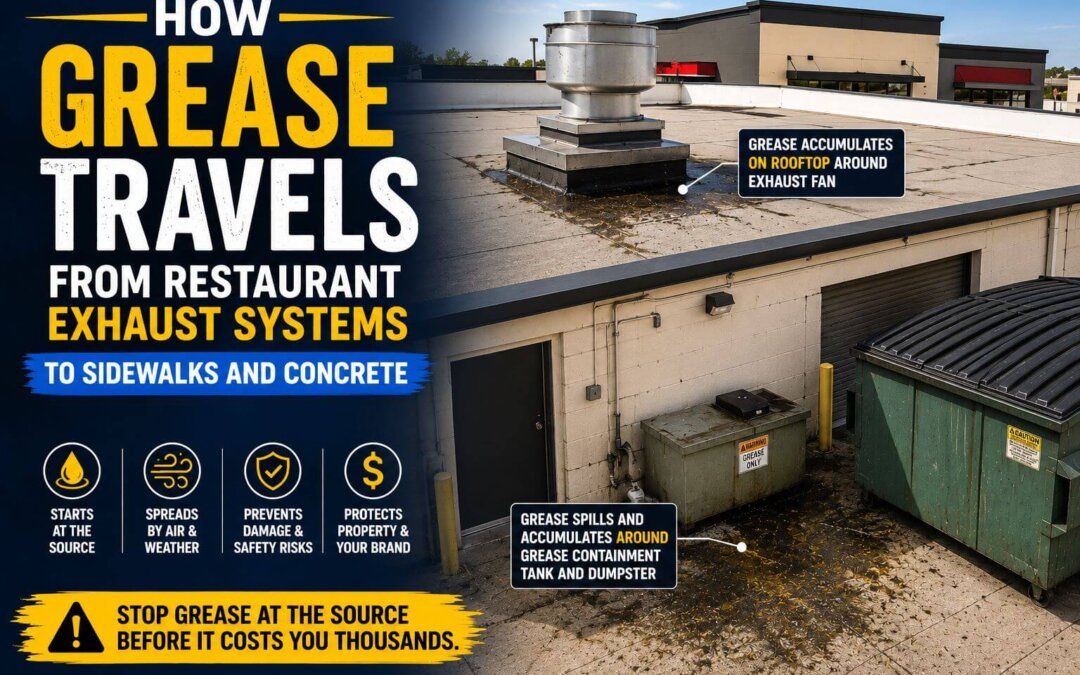
Many restaurant owners assume the grease buildup appearing on their sidewalks, dumpster pads, and exterior concrete surfaces originates exactly where they see it. In reality, much of that contamination begins somewhere completely different: the restaurant exhaust system.
After more than 25 years providing professional hood cleaning, restaurant cleaning, and commercial pressure washing services throughout Arizona and New Mexico, we've found that many exterior cleaning problems can be traced directly back to kitchen exhaust systems. Understanding how grease migrates throughout a property can help restaurant operators protect both their brand appearance and guest safety.

Where The Problem Begins
Every restaurant kitchen generates grease vapor. Fryers, grills, charbroilers, and flat tops release microscopic grease particles into the air during normal operation. The kitchen exhaust system is designed to capture these, but even the best systems cannot prevent all particles from escaping into the environment.
Over time, grease accumulates inside exhaust hoods, ductwork, and rooftop fan systems. Without routine maintenance, these contaminants migrate beyond the kitchen walls. This accumulation is not just a safety hazard; it is the starting point for property-wide contamination that inevitably reaches your customer-facing surfaces.
This migration directly impacts high-traffic customer areas, as we've detailed in our guides on dirty restaurant sidewalks and why restaurant drive-thrus become stained and difficult to clean.
How Grease Reaches The Roof
The first major stop in grease migration is the rooftop exhaust fan. As air exits the building, small grease particles are discharged with it, collecting around fan housings and roof penetrations. Many rooftop exhaust fans operate for 10 to 16 hours per day, every day of the week. Even a small amount of grease escaping during normal operation can accumulate into significant deposits over the course of months or years. Once these deposits build up around the fan housing, they become vulnerable to wind, rain, and maintenance activity that spreads contamination throughout the property. This is why routine hood cleaning is vital—it stops the migration at the source before it can spread to other areas of your building’s envelope.
How Grease Travels Down Exterior Walls
Once grease accumulates on rooftops, gravity takes over. Rainwater, irrigation overspray, and condensation carry grease down building facades. As we previously discussed in our guide on why dirty restaurant sidewalks drive away customers, this streaking creates a negative first impression before a guest even reaches your door. In Arizona and New Mexico, the intense sun literally bakes these contaminants into surfaces, making removal significantly more challenging. When grease is allowed to bake into masonry or painted facades, it requires aggressive treatment that standard building washing cannot provide.
The Connection Between Hood Cleaning And Exterior Appearance
Many restaurant owners view hood cleaning and exterior pressure washing as completely separate services. In reality, they are closely connected pillars of facility maintenance. A properly maintained exhaust system reduces grease discharge throughout the property, while recurring exterior cleaning removes contaminants before they become permanently embedded in concrete and masonry surfaces. The most successful restaurant maintenance programs address both interior exhaust systems and exterior property conditions simultaneously to prevent a feedback loop of recurring contamination.
How Sidewalks and Drive-Thrus Become Contaminated
Eventually, this contamination reaches the ground. Particles settle onto sidewalks, entryways, and drive-thru lanes. When combined with employee traffic and deliveries, these surfaces develop the stubborn black traffic patterns that define neglected properties. This is why recurring commercial pressure washing is an essential layer of property protection. Whether you are maintaining a single location in Gilbert or a growing portfolio spanning Scottsdale, Buckeye, and Albuquerque, the accumulation pattern remains the same across all high-traffic environments.
Dumpster Areas As Collection Points
Grease migration doesn't stop at the sidewalk. Dumpster enclosures often act as collection points for oil, food waste, and runoff. Combined with the exhaust system grease described above, these areas become highly contaminated zones. Consistent dumpster area cleaning is required to prevent these contaminants from being tracked back into public walkways by foot traffic or delivery carts.
Why Arizona And New Mexico Face Greater Challenges
Restaurants in Chandler, Tempe, Scottsdale, Gilbert, and Albuquerque deal with extreme heat that bakes organic contaminants deep into concrete pores. The longer grease remains untreated, the more expensive it becomes to remove. Our environment demands a more robust maintenance schedule than standard commercial properties, as the heat effectively "cures" grease stains into the substrate of your walkways.
Managing Grease Control Across Multiple Locations
For facility managers, maintaining consistency is key. PowerWash Pro's Facilities Portal supports recurring facility maintenance programs by providing access to service history, before-and-after photos, and maintenance documentation from a centralized dashboard. This allows you to monitor activity across your entire portfolio and ensure brand standards are upheld everywhere from Chandler to Albuquerque.
Frequently Asked Questions
Yes. Grease particles accumulate on rooftops and walls, then migrate to sidewalks through rainwater runoff, irrigation, and foot traffic.
Absolutely. Regular hood cleaning limits the volume of grease discharged into the environment, directly reducing the load on your exterior surfaces.
The "black" look is a mix of grease, carbon deposits, food oils, and dirt that has been compressed into the concrete, often "baked in" by the intense Southwestern sun.
Frequency depends on volume, but many restaurants require quarterly service to maintain safety and limit exterior discharge.
Yes. We specialize in comprehensive maintenance plans that integrate interior hood cleaning with exterior pressure washing for total facility care.
Final Thoughts
Grease buildup rarely starts where it becomes visible. By understanding the connection between your kitchen's exhaust system and your exterior concrete, you can take a proactive approach to maintenance. Combining routine hood cleaning with recurring restaurant cleaning services protects your brand image and ensures your property remains professional from the rooftop to the sidewalk. If your property is ready for a professional maintenance audit, contact us today.