
Restaurant operators rarely wake up one morning and discover that their exhaust system suddenly needs cleaning. In most cases, grease accumulation develops gradually over weeks and months until warning signs begin appearing throughout the kitchen and property.
After more than 25 years providing professional hood cleaning, restaurant cleaning, and facility maintenance services throughout Arizona and New Mexico, we’ve found that many restaurant owners don’t realize their system is overdue until the problem has already spread beyond the hood itself.
Recognizing the early warning signs can help prevent fire hazards, equipment wear, grease migration, and expensive corrective maintenance.
Why Restaurant Exhaust Systems Become Overdue For Cleaning
Every commercial kitchen generates grease-laden vapor. As cooking operations continue throughout the day, microscopic grease particles travel through filters, ductwork, fan systems, and rooftop exhaust components. Over time, grease accumulates throughout the entire exhaust pathway.
As we discussed in our guide on how often should restaurant hoods be cleaned, every restaurant generates grease at a different rate. However, every exhaust system eventually reaches a point where cleaning becomes necessary. The challenge is recognizing the warning signs before larger problems develop.
Industry Standards And Cleaning Frequency
Many commercial kitchen exhaust systems are serviced according to cleaning intervals commonly associated with NFPA 96 guidelines. Depending on cooking volume and grease production, operators may require monthly, quarterly, semi-annual, or annual cleaning schedules. High-volume cooking operations generally require more frequent service than lower-grease facilities. Restaurants that exceed these intervals often begin experiencing many of the warning signs outlined above.
Sign #1: Visible Grease On Hood Surfaces
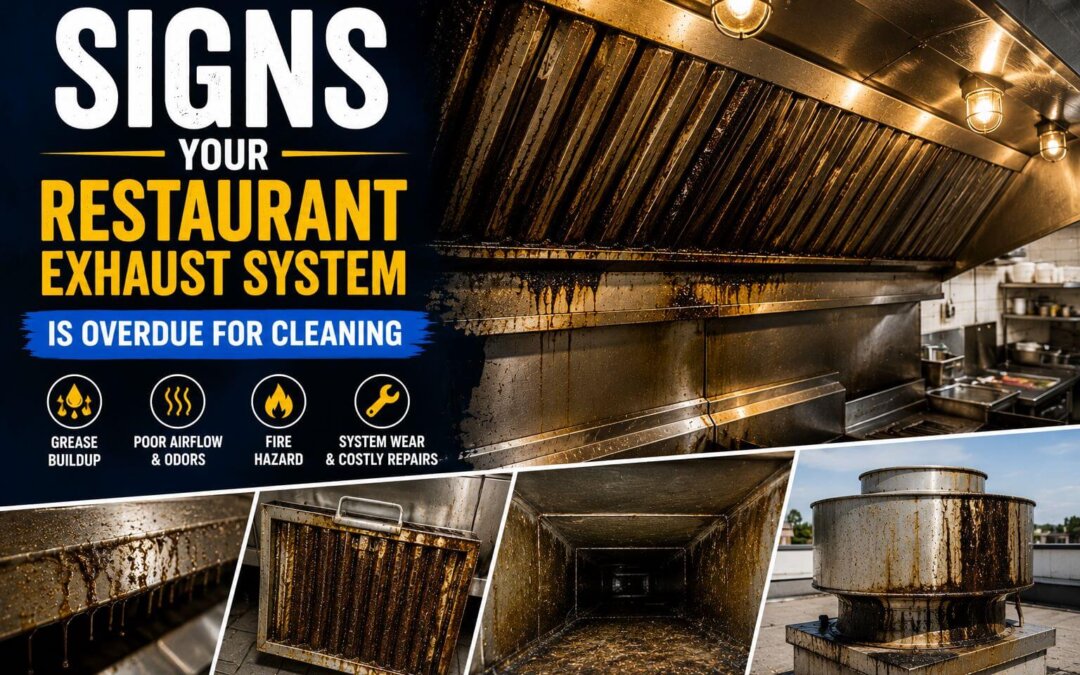
One of the easiest warning signs to identify is visible grease accumulation on the hood itself. If hood surfaces feel sticky, appear discolored, or have visible grease streaking, there is a good chance the contamination extends far beyond what is visible. Grease accumulation on accessible surfaces often indicates larger deposits are forming deeper within the system.
Sign #2: Excessively Dirty Filters
Filters are designed to capture grease before it enters the ductwork. When filters become heavily coated, airflow becomes restricted and system performance begins declining. Signs include dark grease buildup, sticky filter surfaces, reduced airflow, visible dripping grease, and excessive smoke during cooking. Dirty filters are often one of the first indicators that the entire system requires attention.
What Happens When Grease Keeps Building Up?
One of the biggest misconceptions restaurant operators have is that grease simply accumulates on the visible surfaces of the hood. In reality, the entire exhaust system is connected, meaning contamination gradually moves through multiple components over time.
Most systems begin with grease accumulating on the baffle filters. As these filters become increasingly coated, airflow efficiency begins declining. Reduced airflow makes it more difficult for the system to capture smoke, grease vapor, and cooking byproducts effectively.
As grease continues building, excess contamination begins collecting in the grease troughs and collection channels designed to capture runoff. When cleaning is delayed long enough, these areas can become overloaded with liquid grease and hardened deposits.
Meanwhile, smaller grease particles continue traveling through the ductwork where they adhere to interior duct surfaces. Over time, these deposits become thicker and increasingly difficult to remove.
The contamination eventually reaches the exhaust fan assembly on the roof. Fan blades, housings, hinges, and grease containment systems begin accumulating grease as well. Once these systems become overloaded, grease frequently escapes containment and begins spreading across rooftop surfaces. This progression is one reason overdue hood cleaning creates both fire risks and property maintenance issues. What begins inside the kitchen can eventually impact ductwork, rooftop equipment, exterior concrete, sidewalks, dumpster areas, and customer-facing portions of the property.
Sign #3: Grease Dripping From Components
Grease should never be actively dripping from hood components. When grease begins dripping from filters, seams, duct access panels, or fan components, accumulation has typically reached problematic levels. At this stage, delaying service—as noted in our guide on the real cost of delaying restaurant hood cleaning—usually results in more extensive cleaning requirements later.
Sign #4: Increased Smoke In The Kitchen
Another common indicator is excessive smoke. When grease accumulation restricts airflow, exhaust systems become less effective at removing cooking byproducts. Operators often notice more smoke near cooking equipment, smoke lingering longer than normal, reduced ventilation performance, and stronger cooking odors. These symptoms frequently indicate restricted airflow caused by grease buildup.
Sign #5: Strong Grease Or Cooking Odors
Persistent odors can signal exhaust system issues. When grease accumulates throughout ductwork and exhaust components, odors often become stronger and more noticeable. Staff members may stop noticing these smells because they become accustomed to them, while customers immediately recognize something is wrong.
Sign #6: Rooftop Grease Accumulation
One of the most overlooked warning signs is found on the roof. During inspections, we frequently discover significant grease accumulation around exhaust fan systems. As we explained in our guide on how grease travels from restaurant exhaust systems to sidewalks and concrete, that contamination can spread to sidewalks, dumpster pads, drive-thru lanes, and customer entrances throughout the property.
Sign #7: Exterior Grease Staining
When grease begins appearing on exterior concrete, operators often assume the problem originated at ground level. In reality, rooftop exhaust systems are frequently the source. Visible staining near building walls, dumpster pads, sidewalks, drive-thru lanes, and service entrances can indicate that grease migration has been occurring for an extended period. These conditions are often among the exterior issues discussed in our guide on what health inspectors notice outside restaurants. When exterior staining begins appearing throughout the property, many operators combine hood cleaning with recurring restaurant cleaning services to address both the source of contamination and the visible impacts throughout the facility.
Why Hot Water Cleaning Makes A Difference
At PowerWash Pro, we utilize commercial-grade hot water pressure washing systems specifically designed to break down grease. Hot water allows grease to be emulsified and removed far more effectively than cold-water cleaning methods, resulting in better grease removal, more effective restoration, and reduced residual contamination.
Multi-Location Restaurant Challenges
For franchise operators and restaurant groups, identifying overdue systems becomes more complicated. A single neglected location can create compliance issues, increase maintenance costs, and negatively impact brand standards.
We provide recurring hood cleaning programs for independent restaurants, franchise operators, and multi-location groups throughout Arizona and New Mexico, including Chandler, Tempe, Scottsdale, Gilbert, Buckeye, Phoenix, and Albuquerque. Many operators coordinate these efforts through broader facility maintenance programs that combine hood cleaning, restaurant pressure washing, and exterior property maintenance to create consistency.
Visibility Across Every Location
PowerWash Pro’s Facilities Portal gives facility managers and franchise operators complete visibility into maintenance activity across their portfolio. Managers can access service history, before-and-after photos, technician notes, work orders, invoices, and maintenance documentation to ensure no location falls behind on critical maintenance.
Next Steps For Your Kitchen
Many restaurant owners are surprised by what happens during a professional hood cleaning service and how much of the system is actually cleaned. Understanding the process is the final step in ensuring your kitchen remains compliant, efficient, and safe.
Frequently Asked Questions
Visible grease accumulation and excessively dirty filters are often the earliest warning signs.
Yes. Grease restricts airflow and reduces system efficiency.
Persistent grease odors often indicate accumulation within the exhaust system.
Absolutely. Grease migration frequently affects sidewalks, dumpster areas, drive-thrus, and customer entrances.
Yes. PowerWash Pro utilizes commercial-grade hot water pressure washing equipment specifically designed for grease removal.
Final Thoughts
Exhaust systems rarely become overdue overnight. Warning signs usually develop gradually, giving operators an opportunity to address the issue before larger problems emerge. If you’re noticing grease buildup, odors, smoke, rooftop contamination, or exterior staining, your system may already be overdue for service. Contact PowerWash Pro to schedule a professional evaluation and build a maintenance program designed around your operation.