
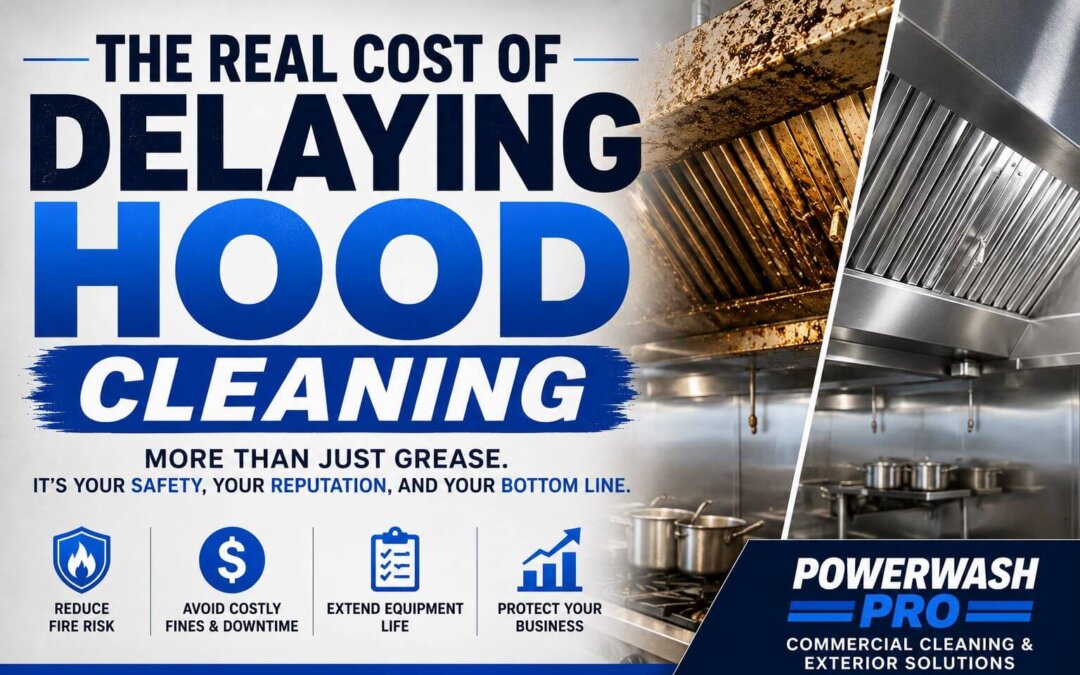
The Real Cost of Delaying Restaurant Hood Cleaning
Many restaurant owners view hood cleaning as a routine compliance requirement. Something that needs to be completed periodically, documented, and filed away until the next service date. After more than 25 years providing professional hood cleaning, restaurant cleaning, and facility maintenance services throughout Arizona and New Mexico, we've learned that this perspective often leads to expensive consequences.
The true cost of delaying hood cleaning rarely appears on the invoice itself. Instead, the costs show up later through grease migration, property damage, equipment wear, increased fire risk, failed inspections, and expensive emergency repairs. What begins as a small maintenance item often grows into a much larger operational problem.
Where Most Problems Begin

Every day your kitchen exhaust system removes grease-laden air from cooking operations. Fryers, grills, flat tops, charbroilers, and ovens all generate airborne grease particles. Although exhaust systems are designed to capture these contaminants, grease inevitably accumulates throughout the hood, ductwork, fan housing, and rooftop exhaust system.
Without routine cleaning, this accumulation continues growing month after month. Eventually, the system becomes less efficient, grease begins escaping into surrounding areas, and the risk profile of the entire property changes.
Fire Risk Is Only Part Of The Story
Most restaurant operators understand that excessive grease buildup creates a fire hazard. However, many don't realize that fire risk represents only one piece of the equation.
Grease buildup also reduces airflow efficiency, forces mechanical systems to work harder, increases rooftop contamination, accelerates equipment deterioration, and contributes to exterior property staining. In many cases, these secondary effects create greater financial losses than the hood cleaning service would have cost in the first place.
Grease Doesn't Stay On The Roof

For this reason, many restaurant operators combine recurring hood cleaning with comprehensive restaurant cleaning services to address both the source of grease and the contamination that eventually reaches sidewalks, drive-thrus, dumpster pads, and customer entrances.
One of the biggest misconceptions we encounter is the belief that rooftop grease remains isolated to the rooftop. In reality, grease rarely stays where it originates.
As we discussed in our guide on how grease travels from restaurant exhaust systems to sidewalks and concrete, grease discharged from rooftop fans eventually migrates throughout the property. Rainwater, irrigation overspray, foot traffic, and vehicle movement help distribute contamination to sidewalks, dumpster areas, drive-thru lanes, service corridors, and customer entrances.
By the time many restaurant owners notice exterior staining, the contamination process has often been occurring for months or years.
The Hidden Cost Of Property Restoration
Grease contamination doesn't simply create cosmetic problems. In Arizona and New Mexico, extreme temperatures bake oils deep into concrete and asphalt surfaces. This creates stubborn staining that becomes progressively more difficult to remove, leading to the issues we outline in our guide on hidden maintenance hazards.
Properties that postpone hood cleaning often find themselves investing in additional commercial pressure washing, concrete restoration, degreasing treatments, and exterior maintenance services that could have been minimized through proper exhaust system maintenance.
Health Inspections And Compliance Concerns
Exterior conditions frequently influence how inspectors, property managers, and franchise auditors view a facility. Excessive grease accumulation near service areas, dumpsters, and walkways can create concerns regarding sanitation standards and maintenance practices.
As we explained in our article on what health inspectors notice outside restaurants, inspectors often begin evaluating a property before they ever enter the kitchen. A clean, professionally maintained property demonstrates operational discipline. Excessive grease accumulation often suggests the opposite.
Why Professional Hood Cleaning Matters

Proper hood cleaning requires more than simply wiping accessible surfaces. Effective service involves cleaning the entire exhaust pathway, including hood interiors, filters, ductwork access points, fan systems, and surrounding grease accumulation zones.
At PowerWash Pro, we utilize commercial-grade hot water pressure washing systems specifically designed to break down grease and remove contamination throughout the system. Hot water cleaning is dramatically more effective than cold water methods because it emulsifies grease rather than simply moving it around.
Multi-Location Restaurant Challenges
For franchise operators and restaurant groups, consistency becomes one of the biggest challenges. A single neglected location can create compliance issues, increase maintenance costs, and impact brand perception.
This is why many regional operators integrate hood cleaning into broader facility maintenance programs. Combining recurring hood cleaning, restaurant pressure washing, dumpster cleaning, and exterior maintenance creates a more predictable maintenance cycle and reduces long-term costs.
Visibility Across Every Location
PowerWash Pro's Facilities Portal allows restaurant groups, franchise operators, and facility managers to review service history, access before-and-after photos, download invoices, and monitor maintenance activity across multiple locations. Whether you're managing one restaurant or an entire portfolio spanning Chandler, Tempe, Scottsdale, Gilbert, Buckeye, Phoenix, and Albuquerque, visibility drives accountability.
Frequently Asked Questions
Cleaning frequency depends on cooking volume, menu type, and operational requirements. Many restaurants require quarterly service, while higher-volume operations may require monthly or more frequent cleaning. We discuss recommended cleaning intervals in detail in our guide on how often restaurant hoods should be cleaned.
Yes. Grease is combustible. Excessive accumulation significantly increases the potential severity of a kitchen exhaust fire.
Absolutely. Reducing grease accumulation within the exhaust system helps reduce grease migration throughout the property.
Hot water breaks down and emulsifies grease far more effectively than cold water, allowing contaminants to be removed rather than redistributed.
Yes. We provide hood cleaning, restaurant pressure washing, facility cleaning, and maintenance programs for individual restaurants and multi-location operators throughout Arizona and New Mexico.
Final Thoughts
The true cost of delaying hood cleaning is rarely measured by the cleaning itself. It appears later through grease migration, equipment wear, exterior contamination, compliance concerns, and expensive corrective maintenance. A proactive hood cleaning program protects your property, your equipment, your staff, and your customers.
If you're evaluating your current hood cleaning schedule or managing multiple restaurant locations, contact PowerWash Pro to build a customized maintenance program designed around your operational needs.